A Parable:
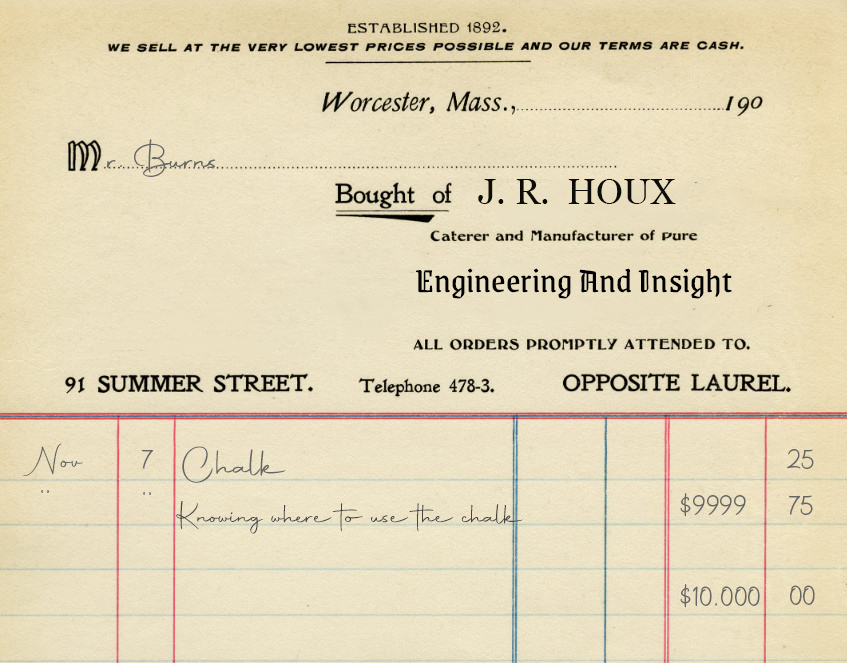
In the early 1900s a large factory making engine parts suddenly started to make parts out of specification. The factory manager brought in several people to figure out what was wrong. No matter how often they changed or reconfigured the machines they just couldn’t get it right, and no part from that line could be sold. Finally they tracked down the engineer who had originally designed the factory line and hired him to fix it. He walked up and down the line while all the machines were running, until he stopped in front of one machine. From his pocket he pulled a piece of chalk and put a large X on the machine. The factory workers pulled that machine out of the line and replaced it, and suddenly everything was working perfectly. The factory manager was thrilled until he received the engineer’s bill, which was $10,000. He was furious because the guy was only there for 15 minutes and he asked for an itemized invoice. A few weeks later he received an invoice in the mail:
If you would like to get notified for new posts subscribe below:
Recent Posts
-
Math, Metrics, and Science Oh My!
Who doesn’t like Math, Metrics, and Science? According to Pew Research, only 11% of Americans say that they liked math in school. Based on most public discourse, this isn’t hard to confirm. I want to look at a couple of commonly used statistics terms and how metrics get misused. This misuse can cause us to…
-
Efficient Meetings: Only immortals don’t care if they take forever
How much time is wasted in meetings? According to Forbes, there are 55 million meetings daily, and at least half don’t accomplish much. Harvard Business Review surveyed 200 senior managers; only 17% said their meetings are generally productive uses of group and individual time. A recent survey shows 93% of workers complain about their recent…
-
Are AI Answers A Money Pit?
Summary: Using the Cynefin sensing model, we can better understand how to use AI in different situations while recognizing its limitations and strengths in each. For simple problems, AI generation is more expensive and prone to inconsistency when automation could be used instead. For complicated problems, The AI user’s understanding of the situation is critical…
-
Checklists: Organize your Personal and Professional life
Summary: Checklists save lives in surgeries and aviation Checklists are useful in personal life for tasks like packing and maintaining work-life balance The article provides examples into creating checklists for daily, weekly, and monthly tasks. The Importance of Checklists This topic may be boring. Unfortunately, even important things can be boring, and checklists are important…
-
High Volume Waste – The Unsung Promise of AI
A Word on Waste Whether it was when I was getting my MBA learning lean manufacturing or lean software development, I learned that we needed to focus on reducing waste to be successful. There were eight main kinds of waste to reduce in a process (manufacturing or software development). To remember them all, there is…
-
Visualize Everything – Manage none of it
Summary: Visualizing how work gets done, the work product, or support systems can help teams improve their work. Taking visualizations used by teams and adding management incentives and goals around them can hurt the ability of those teams not improve them. Managers can use visualizations as an opportunity to ask questions and support their teams. …
-
Lean Godzilla
Summary Godzilla Minus One won the Oscar for Best Visual Effects despite having a much lower budget than its competitors. The film’s VFX team consisted of only 35 people, yet they created stunning effects, proving that having a smaller, more efficient team can lead to success. The team’s lean and agile practices, such as having…
-
Understanding the Psychology of Influence: Empowerment Over Manipulation
Overview Since college, I have found immense value in Robert Cialdini’s book Influence: The Psychology of Persuasion. I revisit it regularly, as Cialdini consistently updates it with fresh stories, analogies, and psychological insights. This is a must-read for business, marketing, and product design professionals, as it comprehensively explains the various strategies used to influence our…
-
Skin in the Game: Avoid playing with house money
Summary: Accountability is critical when making decisions that impact others. To be accountable, we must feel we have something to lose if we are wrong. The decision makers’ loss should be aligned and proportional to those impacted by their decisions. Nassim Taleb’s book “Skin in the Game” illustrates this way of thinking and shows how…
-
Drawing a BEAD on value
People often confuse many things for value. Here are just some of them: excitement, urgency, trends, hype, complexity, interest, short-term cost savings, ease, loudness, and quantity. Let’s try and categorize these. Fooled by who was saying it Many of these things are confused for value because of who says it. A well-known acronym in product…
-
Failing Forward: Preventing a Culture of Falling Back
Summary: Failure is not always a problem and in Amy Edmonson’s recent book, Right Kind of Wrong: The Science of Failing Well, she categorizes them into three types: Basic, Complex, and Intelligent. The type of failure you experience depends on the problem domain you are working in and can be Safe-to-Fail or Fail-Safe. People at…
-
Feature to Noise Ratio
Summary Humans have limited working memory and need repetition and sleep to store memories in the long-term memory Communication used to be infrequent and costly, but now it’s practically free and instant Reduced cost and speedy delivery have led to increased frequency but reduced information in messages. The increased number of messages with low information…
-
From Dinosaurs to Datacenters: How Jurassic Park’s IT Mistakes Still Apply Today
If you’re a fan of Jurassic Park, you may remember the iconic line, “spared no expense.” However, when it came to IT, John Hammond made some serious mistakes that still apply to tech today. This article will explore how Hammond’s choices impacted the park and how they can be applied to modern-day IT and software…
-
Installing Business Software: it is like bringing a potentially dangerous animal into the jungle where you live.
Summary: Installing software in businesses is like introducing a dangerous animal into a jungle. It isn’t just that the software may not do what you want like a dangerous animal, but your business is complex like a jungle. The interaction between the two can cause unforeseen consequences. Software-as-a-service (SaaS) can make things worse, as businesses…
-
When are SMART goals Dumb?
Summary SMART is an acronym for helping set specific, measurable, achievable, relevant, and time based goals. SMART based goals may not always be the best approach, especially for subjective, long-term, or personal goals. When creating a personal development plan, consider your intrinsic motivations. Focus on the journey and set open-ended goals that align with personal…
-
Assumption Mapping – Preventing Hope-Based Product Delivery
Summary: Learn how to mitigate product failure before it happens with powerful techniques like Assumption Mapping to ensure project success. Reducing the chance of product failure can be accomplished by surfacing and mitigating assumptions, risks, and fears before starting development. The alternative is hope-based management, aka gambling. One method for surfacing concerns is Assumption Mapping,…
-
9th Kind of Waste – Ego
Summary: Creating an undesired product is a wasteful practice that can stem from various reasons, among them being the creator’s ego. Sometimes we confuse our ego with empathy and assume that we know what our customers want without checking if it aligns with their actual needs. Making decisions based on ego can lead to success…
-
Visualizing & Mitigating Risk
Summary Part of a product manager’s job is to reduce the chance of an undesirable outcome, aka risk, of their product’s release. Humans are inherently bad at perceiving chance or changes in chance, which is one reason gambling is problematic. Since humans are naturally unskilled in perceiving chance/risk, methodologies for calculating and visualizing are needed…
-
Interview your Manager like a Customer
Summary Customer interviews are not limited to customers. You can gain insights from anyone that you seek to better understand, managers, employees, and even family. Customer interviews are not a conversation. They are a skill that needs to be developed like any other. The insight that is gained from customer interviews should be verified by…
-
How We Can Trust Generative AI
Summary: Knowledge is the most important strategic resource for companies (Zack, M.H. 2015) Typically, you only want to use the knowledge you trust, and while you can’t trust AI you can trust the experts that validate what it creates. There are new opportunities for companies to use AI as an organization expert. That same opportunity…
-
The Hidden Costs of Delay
Summary: Most people know time is money but we don’t always act that way. Frequently we ignore the time value of money when evaluating a project and if we do, we build hidden costs and lose opportunities. For high-value projects, development costs are typically the least important metric but the easiest to calculate. The ease…
-
Market Fit Debt
Summary: Efficiency and Effectiveness are the two vectors we want to control when trying to meet market demand. When we fail to meet market fit we generate debt that we need to pay off by refining our product to align with the market. This was the original analogy used for technical debt. Technical debt has…
-
Business Hertz
Summary In the past 40 years the focus in business school and in industry is around efficiency (lean, six sigma, theory of constraints), but effectiveness and market timing are becoming even more important as the rate of change in markets is increasing. Businesses fail faster on what they build than on how much it costs…
-
Complexity is Key – Software is not a Toaster
Summary: By identifying the complexity of a problem, you can identify the right method for solving it. The Cynefin framework is a model that can be used to help understand the different levels complexity. Software product development usually remains in the complex domain because both the market and the product are continually changing. The more…
-
Users, Not Great Ideas Dictate Success
Summary: Brilliant ideas from senior leaders can be dangerous due to cognitive bias. There are only 2 predictors to a successful product, 1. It doesn’t get canceled 2. Users proactively choose to use it. Knowing who your users are and what they will use is the most important thing to figure out. In internal company…

